
TABLE OF CONTENTS
- Summary
- What is the purpose of the annual report?
- Who needs to submit an annual report?
- What timeframe does the reporting period cover?
- When do I need to submit the annual report?
- How does First AML help reporting entities with their annual report obligations?
- How do I submit the annual report?
- I have some questions about the data provided, who can I contact?
- Who can I contact for help/further clarification?
Summary
This article addresses common questions about Annual Reports for New Zealand reporting entities.
What is the purpose of the annual report?
All FMA, DIA and RBNZ-supervised reporting entities must submit annual reports detailing their AML/CFT programme and risk assessment. Reporting entities are encouraged to use the annual report to review and update the status of their risk assessment and AML/CFT programme.
The annual report enables supervisors to understand how each reporting entity is meeting their AML/CFT obligations, how they are assessing and mitigating the risks of money laundering and terrorist financing to their business, and how they are managing their financial activities.
Who needs to submit an annual report?
Reporting entities must submit an annual AML/CFT report to their relevant supervisor.
- The FMA supervises designated business groups (DBGs) and reporting entities listed in Section 130 of the AML/CFT Act.
- The RBNZ supervises banks, life insurers, and non-bank deposit takers.
- The DIA covers casinos, non-deposit-taking lenders, money changers and reporting entities not covered by the other supervisors, for example real estate, accounting, legal, trust and company providers.
Certain reporting entities with a full or partial exemption from the AML/CFT Act may be exempt from submitting an annual report.
What timeframe does the reporting period cover?
The reporting period runs from 1 July to 30 June.
When do I need to submit the annual report?
The annual AML/CFT report for each period must be submitted any time between 1 July and 31 August via the AML Online portal.
How does First AML help reporting entities with their annual report obligations?
Compliance Admin users can view, filter and download the information via the Reporting > Regulatory Reporting section of the platform. We have pre-filtered the date ranges for the regulatory report to align with the reporting period. See this article for detailed instructions on the reporting page.
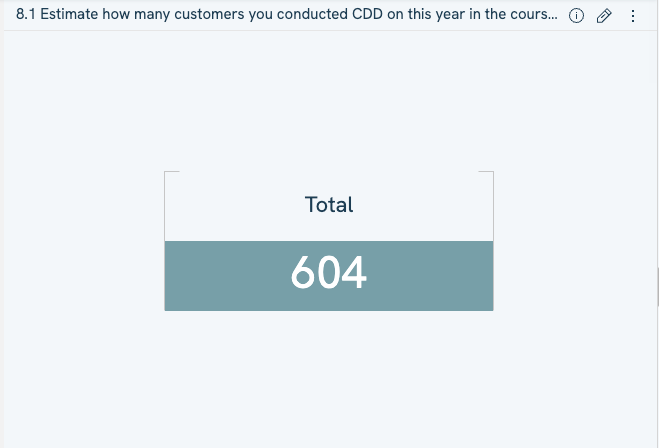
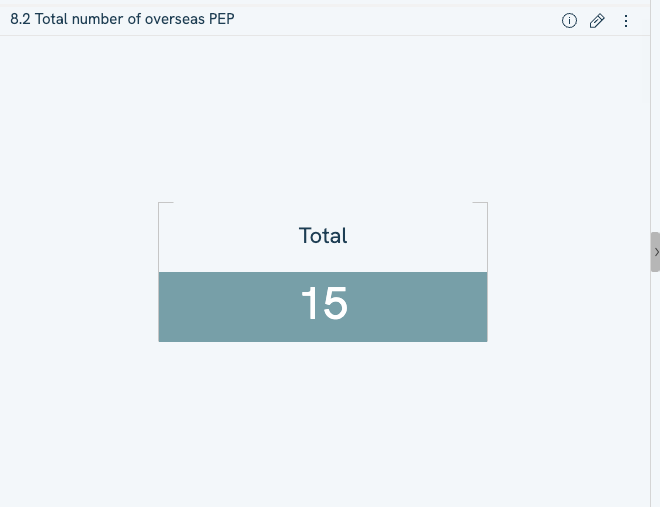
- For DIA-supervised reporting entities, customers can download information directly from the reporting section in the platform for the answers to questions in Part 3, Section 8.1-8.2 of the annual AML/CFT report user guide. This includes information on the number of total customers onboarded, the number of PEPs, overseas entities, and so on.
- For FMA/RBNZ-supervised reporting entities, we can provide information for the questions in Part 3, Section 7.1-7.5 of the annual AML/CFT report user guide.
Please note we cannot help submit the report for you, or provide any further information beyond the questions in Section 8 (DIA) or Section 7 (FMA) of the annual report.
FMA data note (correct as of the 2025/26 reporting period, review annually):
We are currently providing FMA data on request. Email your customer success manager or submit a ticket to the Help Centre for support, and a member of our team will be in touch with next steps.
Regulatory reporting in the platform
Section 8: Reporting definitions and data sources
Question | First AML Definition | Data Provided |
|---|---|---|
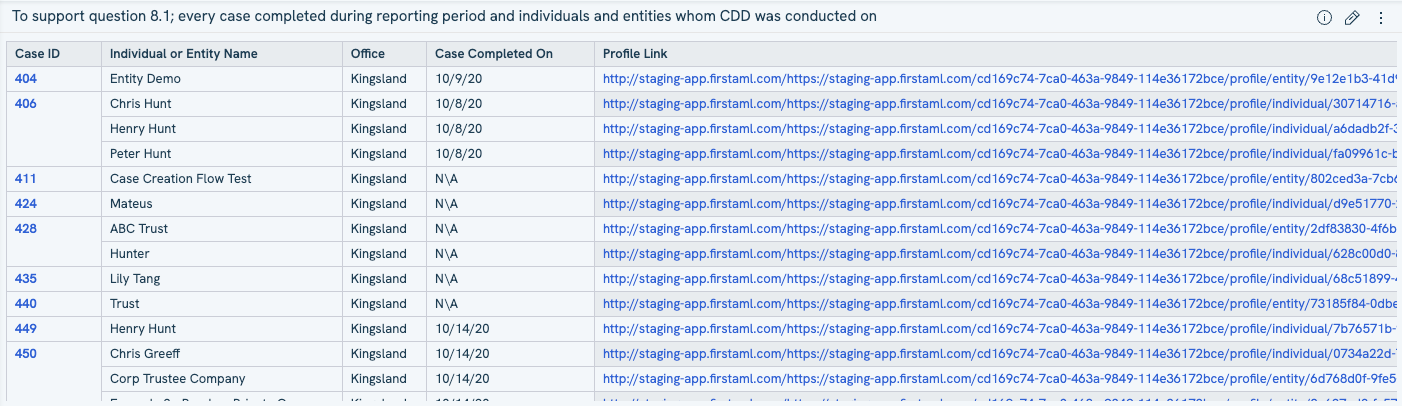
| 8.1 – Estimate how many customers you conducted CDD on this year | Total number of individuals or entities that have been assigned a “Pass” status during the reporting period. | Total number of unique active profiles. Includes all cases completed during the reporting period and all individuals/entities with completed CDD. Data includes:
Duplicates may exist if CDD was performed multiple times. |
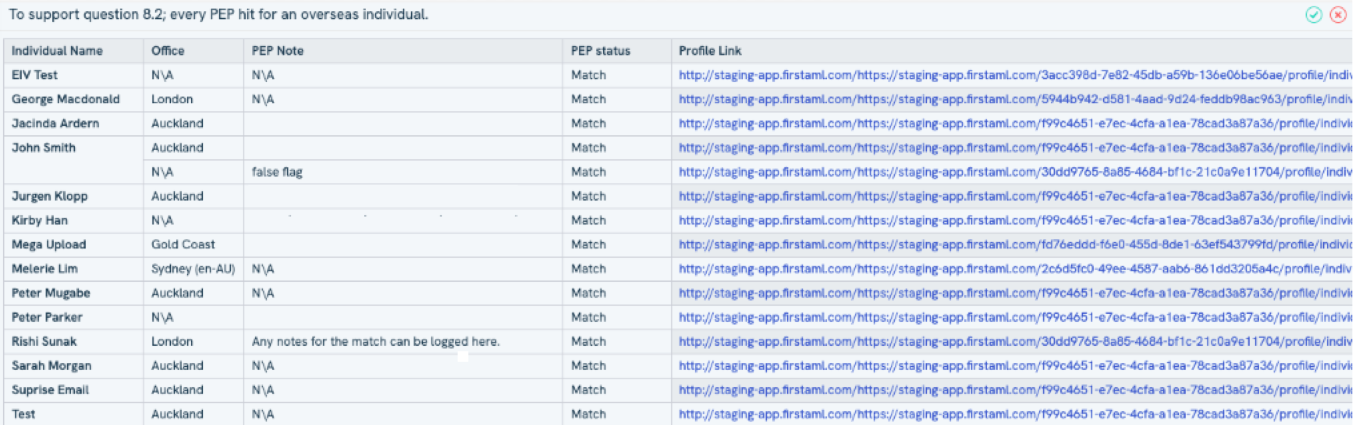
| 8.2 – Total number of overseas PEPs | Every individual who has a PEP hit with a “True Match” status and an address outside of New Zealand. | Total number of unique active individual profiles. Supporting data includes:
|
| 8.2 – Trusts or Other Vehicles for Holding Personal Assets | Total number of entities that are classified as trusts (e.g., family trusts, discretionary trusts) or other legal arrangements used primarily for holding or managing personal assets, as identified by the entity type during the reporting period. | All entities displayed by:
|
| 8.2 – Total number of overseas government bodies | Total number of entities with the entity type “Government body” and an address outside of New Zealand. | Total number of unique active entity profiles. Supporting data includes:
|
Examples of what you will see in the platform:
How do I submit the annual report?
- If you are DIA-supervised, you can complete your annual AML/CFT report online using AML Online, a secure platform for businesses to engage with the regulator online.
- If you are FMA-supervised, you can complete your AML/CFT annual report via the FMA's RealMe login portal (link provided by the FMA).
I have some questions about the data provided, who can I contact?
Please email your customer success manager, and our support team (help@firstaml.com) or submit a ticket to the Help Centre for support. A member of our team will be in touch to help with your query.
Who can I contact for help/further clarification?
- Please refer to the DIA annual AML/CFT report explanation page, the FMA Annual Report User Guide and the DIA Annual Report User Guide for more information.
- If you have any specific questions about the annual AML/CFT report, contact the DIA at amlcft@dia.govt.nz or the FMA at aml@fma.govt.nz.
- Our customer success team can also refer you to our network of trusted AML professionals and consultants who can provide additional assistance.