
TABLE OF CONTENTS
- What is email authentication
- Why do I need it?
- How does this benefit me?
- How do I use it?
- Troubleshooting:
- Frequently asked questions:
- What else can I do to secure my account?
- Do I need to set up my email authentication?
- Can I turn off email authentication?
- What if I lose access to my email?
- How often will I need to authenticate via email?
- Can I use a different email for authentication?
- Why is my email code taking so long to get to my inbox?
Applies to: all First AML users, on all plans and regions. It requires no setup; it's automatically the fallback whenever multi-factor authentication (MFA) is switched off.
What is email authentication
Email authentication is the fallback second factor on First AML. By default, all users have multi-factor authentication (MFA) enabled, and they verify their identity at login using an authenticator app or security key. If MFA is switched off for a user, either by themselves or by an admin in their organisation, the platform falls back to emailing a six-digit one-time password (OTP) at each login. See Multi-factor authentication (MFA) for our recommended setup.
Why do I need it?
Email authentication enhances the security of your account by ensuring that only you can log into your platform. This reduces the risk of unauthorised access, keeping your personal information and account activities secure.
How does this benefit me?
- Adds a layer of security to your account that helps prevent bad actors from gaining access.
- Protects access to your clients' sensitive data and information.
- Reduces the likelihood that you'll be a victim of an attack.
How do I use it?
- Log in: enter your email and password on the login page.
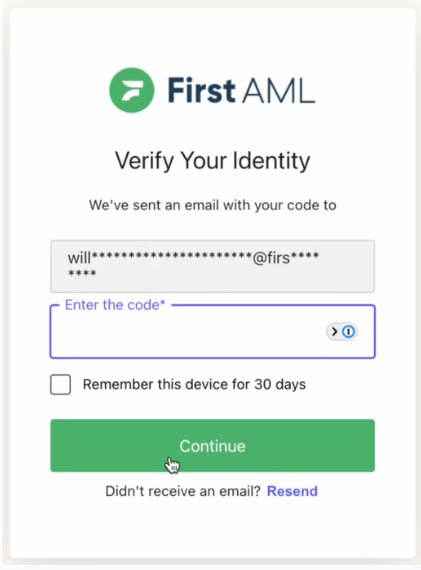
- Receive OTP: after submitting your credentials, a unique six-digit code (OTP) will be sent to the email address you entered.
- Enter OTP: check your email for the OTP and enter it in the required field on the login page.
- Access account: once the OTP is verified, you'll gain access to your account.
- Remember this device: on the OTP screen, you can select "Remember this device for 30 days" so you won't be asked for a new code on that device until the 30 days are up. If you don't select this, you'll be prompted to authenticate on every login attempt.
Troubleshooting
I didn't receive the email with my OTP?
- Ensure you have entered the correct email during the login process.
- Check your spam/junk folder.
- Wait a few minutes, the email may be slightly delayed.
- Ensure that you are checking the correct email account. The authentication code is sent to the email address associated with your First AML account. If you still don't receive the email, please contact our support team at help@firstaml.com.
- The code is sent from noreply@firstamlusers.com. Check that this sender isn't being blocked or filtered. If your IT team manages an allowlist, ask them to add this address.
My code isn't working?
- Make sure you've entered the code exactly as it appears in the email.
- The OTP is valid for a limited time, so use it promptly. If too much time has elapsed, click the "Resend" button on the login page to get a new code.
I'm still having issues.
- Contact our support team at help@firstaml.com.
Frequently asked questions
What else can I do to secure my account?
MFA is the default and most secure way to verify your identity on First AML. If MFA is currently off for your account, we strongly recommend turning it back on. See Multi-factor authentication (MFA) to get started. If you have any questions, please reach out to security@firstaml.com.
Do I need to set up my email authentication?
Email authentication only kicks in if MFA is switched off for your account. With MFA on (the default), you won't see email codes; you'll use your authenticator app or security key instead.
Can I turn off email authentication?
Email authentication only applies when MFA is off. Enabling MFA replaces email authentication with an authenticator app or security key, which is faster and more reliable. We strongly recommend keeping MFA on. See Multi-factor authentication (MFA).
What if I lose access to my email?
Contact our support team for assistance at help@firstaml.com.
How often will I need to authenticate via email?
When signing in you can select the option to "Remember this device for 30 days". You will only need to re-enter the code after 30 days. Otherwise, you'll be prompted to authenticate whenever there's a login attempt on your account.
Can I use a different email for authentication?
The authentication code is sent to the email address associated with your First AML account. Contact our support team if you need to change the email address related to your account.
Why is my email code taking so long to get to my inbox?
You may need to discuss with your IT team to ensure that First AML is allow listed by your email servers.