TABLE OF CONTENTS
Summary
This article explains what a Person with Significant Control (PSC) is, how PSCs are automatically surfaced in an entity's structure when you use KYB Unwrap, how to see more detail on a PSC's specific relationships via the Manifest, and what it means when a PSC is tagged as "super-secure."
Note: PSCs are a UK-specific concept, tied to Companies House requirements. This article applies to UK-registered entities only.
What is a PSC?
A Person with Significant Control (PSC) is an individual or entity that has substantial influence or control over a UK-registered company, Societas Europaea (SE), limited liability partnership (LLP), or eligible Scottish partnership (ESP). They’re sometimes called ‘beneficial owners’.
These entities must identify and record all PSCs and report any changes in their details or the nature of their control to Companies House within 14 days. As a result, the PSC register is generally the most current source of information.
Most companies will have at least one individual or entity listed as PSC. There may be certain situations where an entity does not have a PSC surfaced. For more information regarding PSCs please refer to this gov.uk guide on PSC requirements.
Reviewing your client's PSCs is crucial for understanding the ownership structure and verifying the appropriate individuals.
Most PSCs are those who hold directly or indirectly:
- more than 25% of shares in the company
- more than 25% of voting rights in the company
- the right to appoint or remove the majority of the board of directors
- the right to exercise, or actually exercises, significant influence or control over the company.
How are PSCs surfaced within KYB Unwrap?
KYB Unwrap is First AML's feature that combines an entity tree builder with up-to-date company registry data from global registries, automatically retrieving and mapping an entity's ownership structure in a single click.
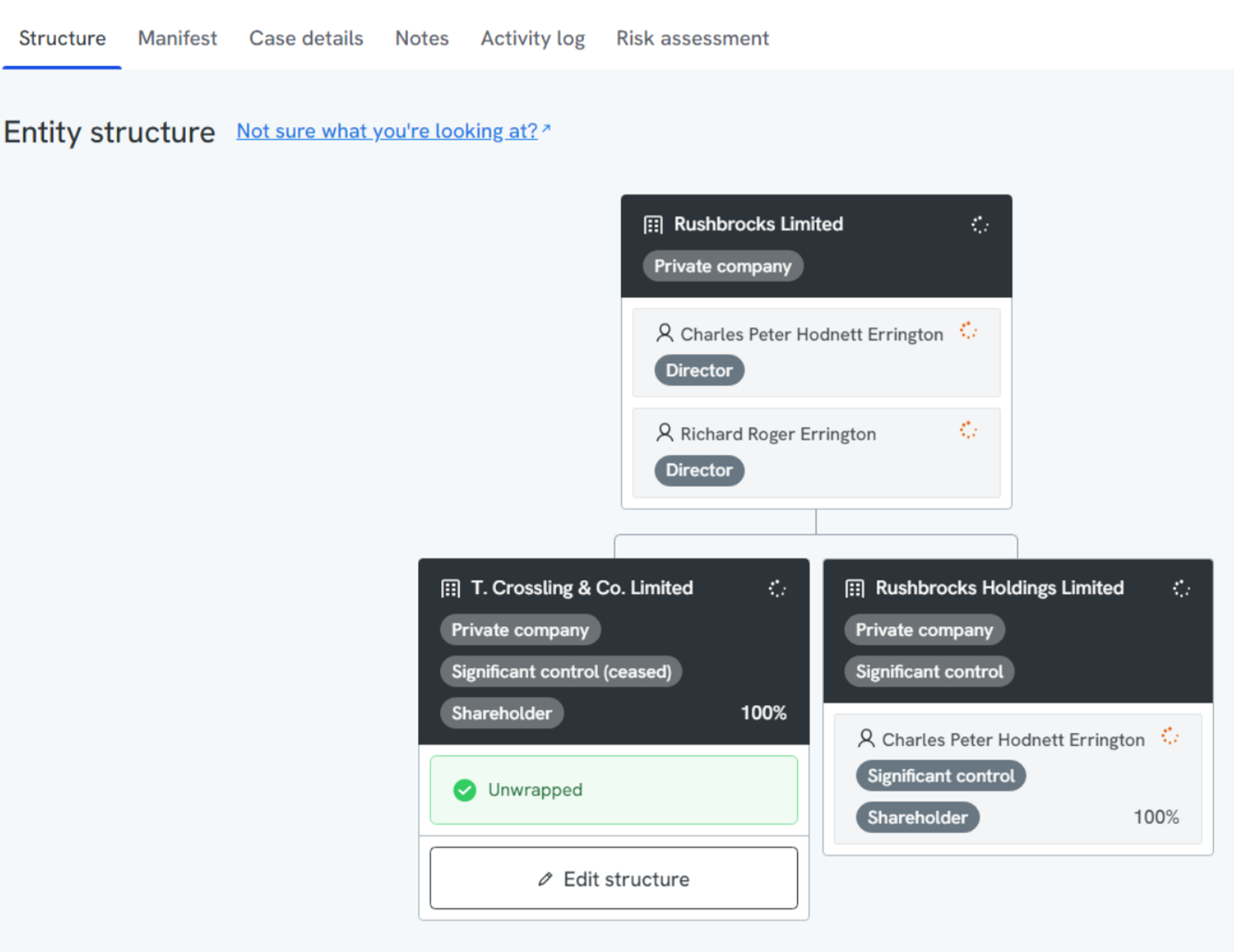
The First AML entity structure automatically labels individuals or entities with Significant Control via the ‘unwrap’ feature.
- "Significant Control": current PSCs, whether a Director and/or Shareholder or not, are added to the structure with this tag.
- "Significant Control (ceased)": PSCs who have ceased their controlling relationship, but remain a current Director and/or Shareholder, are added to the structure with this tag.
To understand the specific type of control/ownership each PSC has, refer to the Entity summary report within the Manifest tab (the tab within a case that acts as a centralised hub, listing requirements and the actions available to fulfil them).
Worked example
In the entity structure above for Rushbrocks Limited, T. Crossling & Co. Limited is tagged "Significant control (ceased)" it's a 100% shareholder whose controlling relationship has ended. Rushbrocks Holdings Limited, on the other hand, is tagged "Significant control," as is the individual Charles Peter Hodnett Errington, who holds a current 100% shareholding within it. This shows how the same structure can surface both current and ceased PSCs side by side, without either one disappearing from view.
Understanding PSCs with Manifest
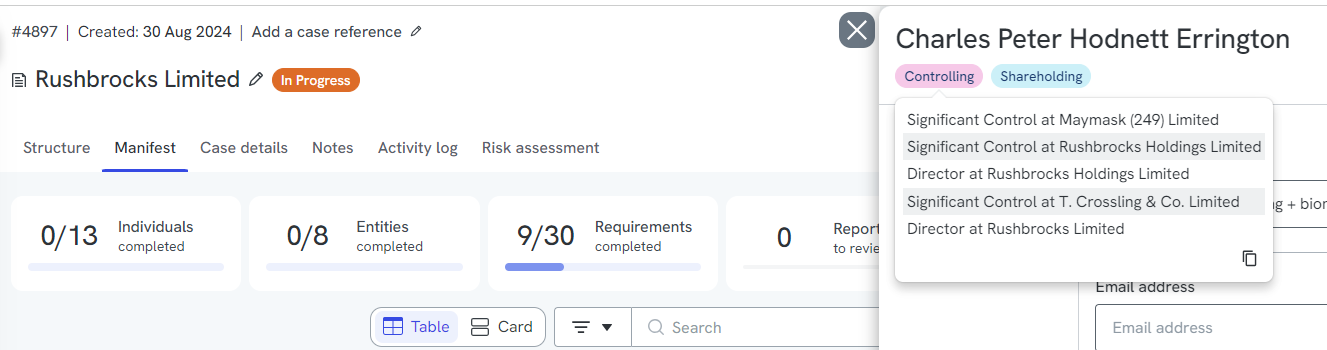
Within the Manifest, you can click on an individual or entity's Controlling tag (the "Significant Control" or "Significant Control (ceased)" label) to see additional detail on the types of relationships that individual or entity holds within a group of companies — for example, whether their control comes from shareholding, voting rights, or the right to appoint directors.
What is a super-secure person with significant control beneficial owner?
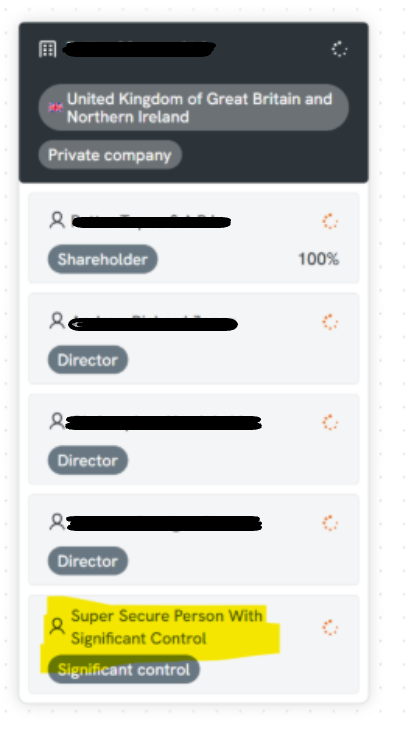
This tag means that PSC details are "super-secure", which is a special category in Companies House. UK law allows certain PSCs to be "super-secure", meaning their personal details are protected and not publicly disclosed for privacy or safety reasons (e.g., law enforcement, witness protection).