
TABLE OF CONTENTS
- Overview
- How it works
- The accepted document combinations
- What gets checked
- Setting it up
- Running a verification
- Reading the report
- When a name does not match
- When identity has already been verified
- What to expect
- Related articles
Overview
VOI lets you complete an ARNECC Verification of Identity in a single flow. The individual provides one of a set of accepted document combinations, and First AML verifies the documents and produces a VOI report.
VOI is a verification type. For an overview of all verification types, see Understanding verification types. Documents can be collected through the EIV form, or uploaded to the platform manually.
Use this for conveyancing and property work that requires Verification of Identity. If your requirement is 100-point identity verification instead, see Verifying identity with the Australian 100-point standard.
How it works
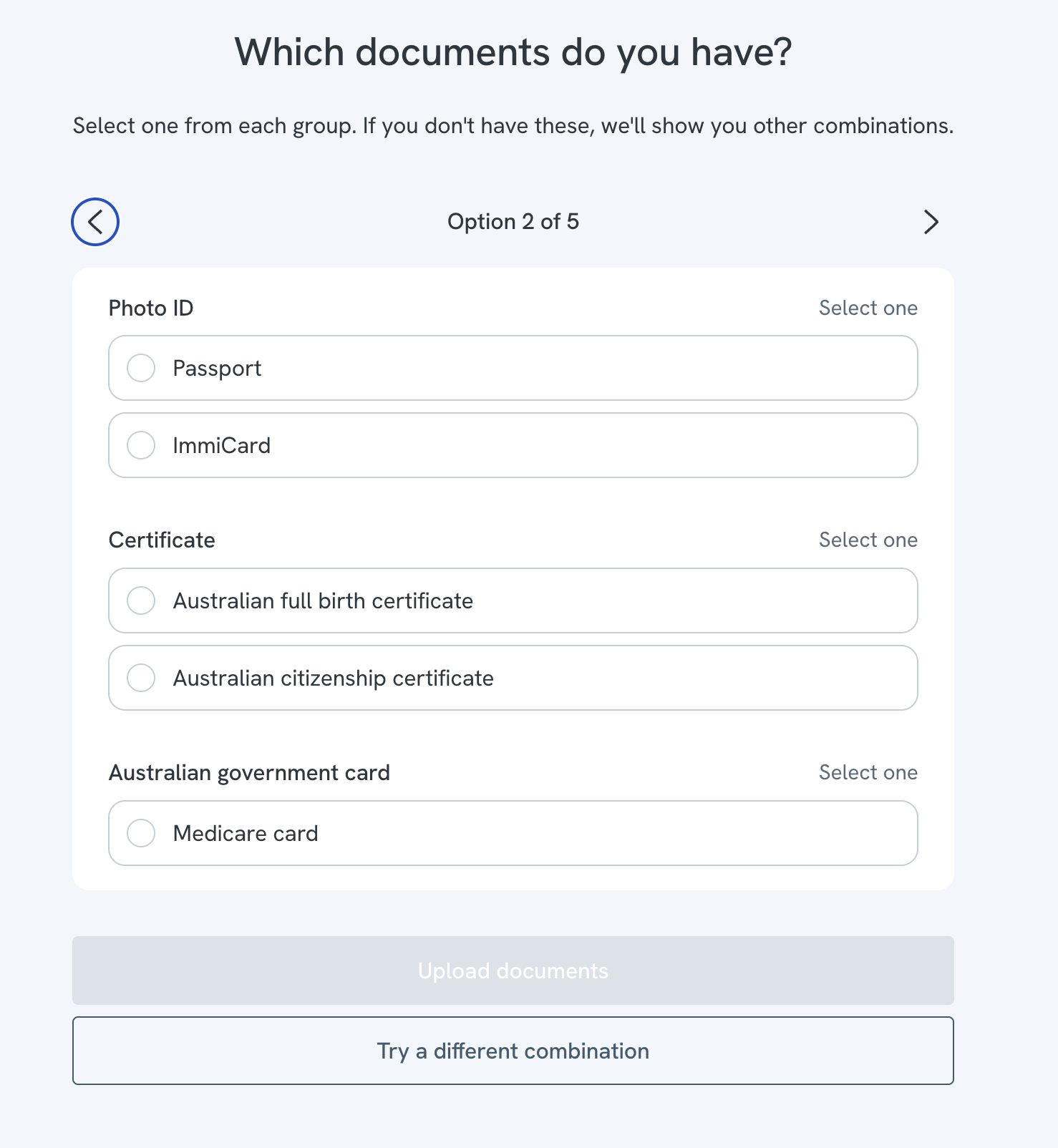
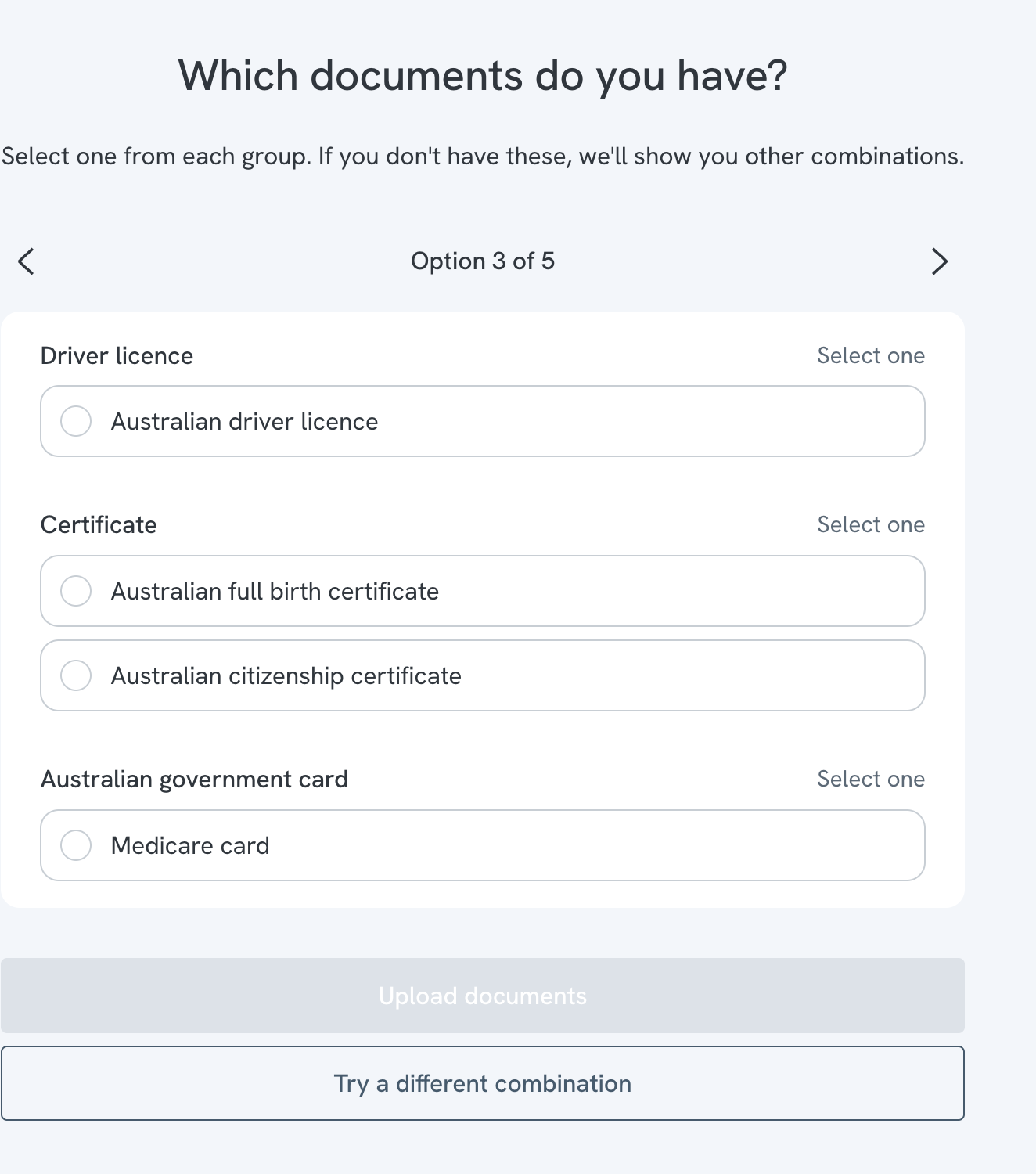
When you use the VOI verification type, the EIV form asks the individual to provide one of five accepted document combinations. The individual chooses which combination to use.
First AML then runs the appropriate checks on each document and produces a single VOI report showing the combination provided and the results of each check.
The accepted document combinations
Each combination satisfies one of the ARNECC VOI Standard categories.
| Option | What the individual provides | ARNECC category |
|---|---|---|
| 1 (default) | Passport or ImmiCard, plus an Australian driver licence | Category 1 |
| 2 | Passport or ImmiCard, plus a birth or citizenship certificate and a Medicare card | Category 2 |
| 3 | Australian driver licence, plus a birth or citizenship certificate and a Medicare card | Category 3 |
| 4 | Passport or ImmiCard, plus another government-issued photo ID | Category 4(a) and 6(a) |
| 5 | Passport or ImmiCard, plus a birth certificate and another government-issued ID | Category 4(b) and 6(b) |
What gets checked
What First AML can verify depends on the document and where it was issued.
| Document | Anti-tampering check | Government source check | Face match |
|---|---|---|---|
| Passport | Yes | Most countries | Yes |
| ImmiCard | Yes | Australia only | Yes |
| Driver licence | Yes | Australia and New Zealand | Yes |
| Birth or citizenship certificate | No | Australia only | No |
| Medicare card | No | Australia only | No |
| Another government-issued photo ID (for example, a foreign driver licence or national ID) | Yes | Varies by country | Yes |
Coverage varies by document and country. For the full list of what we can check and where, see our data sources page. Anything that can't be verified electronically is still collected and shows on the report as Unverified.
For more on how anti-tampering and face match results work, see Understanding ID anti-tampering, anti-fraud and biometric checks.
Setting it up
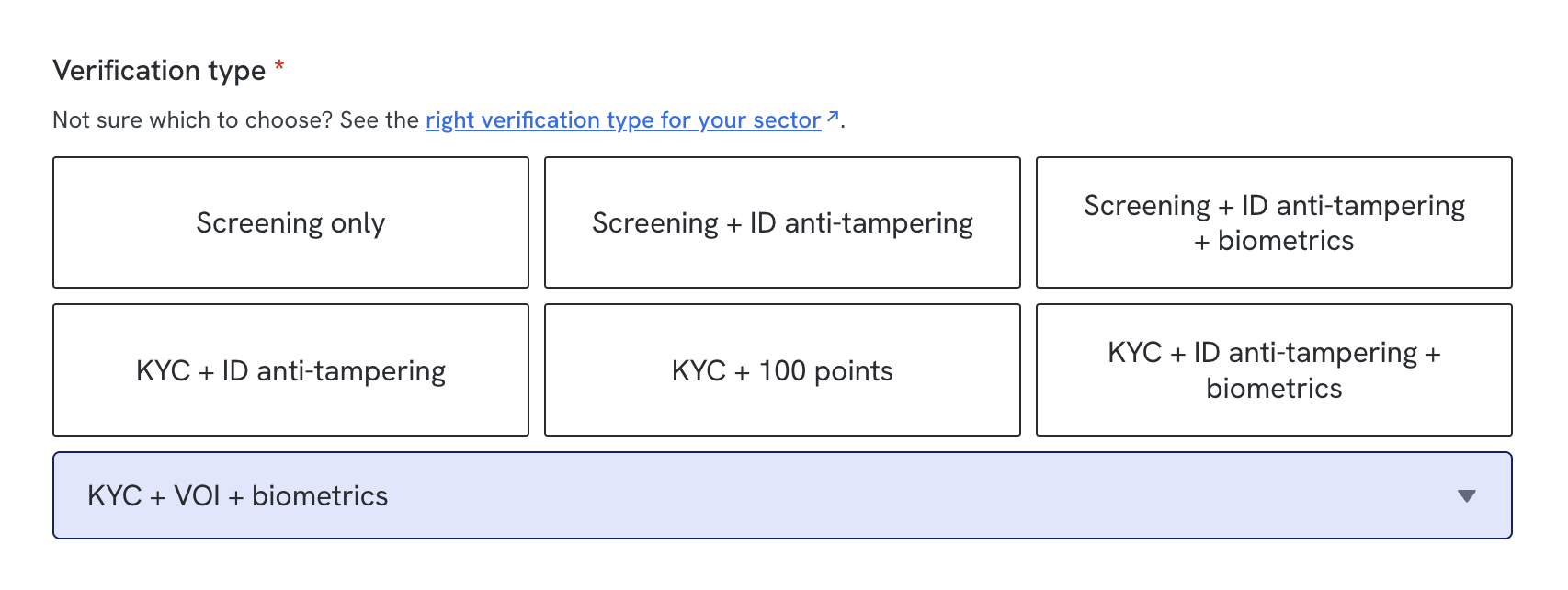
VOI comes as one verification type: KYC + ID anti-tampering + biometrics + VOI.
This type also verifies the individual's name, date of birth and address, and screens them against PEP, sanctions and adverse media lists, as other KYC verification types do.
Availability: the VOI verification type is available in Australia only.
You can also use this type to verify a client in person. See How to verify clients in person.
To use it, ask your Customer Success Manager (CSM) to enable it for your account. Once it's enabled, select it from the Verification type dropdown when you set up the verification, the same way you choose any other verification type. See How to select and change a verification type.
Running a verification
- On the case, check that the VOI verification type is selected.
- Send the EIV form to the individual as usual. See Sending ID and secure webforms.
- The individual chooses a combination, captures each document, and submits the form.
- Once the form is submitted, First AML runs the checks on each document.
- When the checks finish, the report appears automatically. No manual step is needed.
If a document is already on the case, with all its details filled in and still current, the individual isn't asked to capture it again. See "When identity has already been verified" below.
Reading the report
The report opens with the identity standard and shows:
- the combination the individual provided;
- each document, with its own check results;
- a name consistency tile, showing whether the names on the documents match each other.
For general guidance on verification reports, including how to find and download a report, see Understanding individual verification reports.
When a name does not match
If the name on a document differs from the individual's legal name, for example after marriage or a change of name, the form flags it. The individual can then add a marriage certificate or change of name certificate that links the two names.
- If they add a certificate that links the names, the report shows the names as reconciled.
- If they continue without one, the report shows an unresolved name mismatch for your team to review.
When identity has already been verified
If First AML has already verified an individual's identity, on another case or earlier on this one, that verification is reused. The individual doesn't have to recapture what's already been done.
What to expect:
- The documents, checks and, where biometrics were used, the biometric video from the earlier verification are carried onto the new case.
- The form is still sent to the individual. If they were verified before with fewer documents than this verification type needs, for example with a single ID, the form is how they add the missing documents.
- In the form, a document that's already been collected is marked as already collected. For privacy, the individual can't see that document or the details captured from it, but it's clear they don't need to submit it again.
Related articles
- Understanding verification types
- Understanding individual verification reports
- Verifying identity with the Australian 100-point standard
- Understanding ID anti-tampering, anti-fraud and biometric checks
- How to request conveyancer verification
- Australian Driver Licence number and card number
- Sending ID and secure webforms
- Using the Manifest